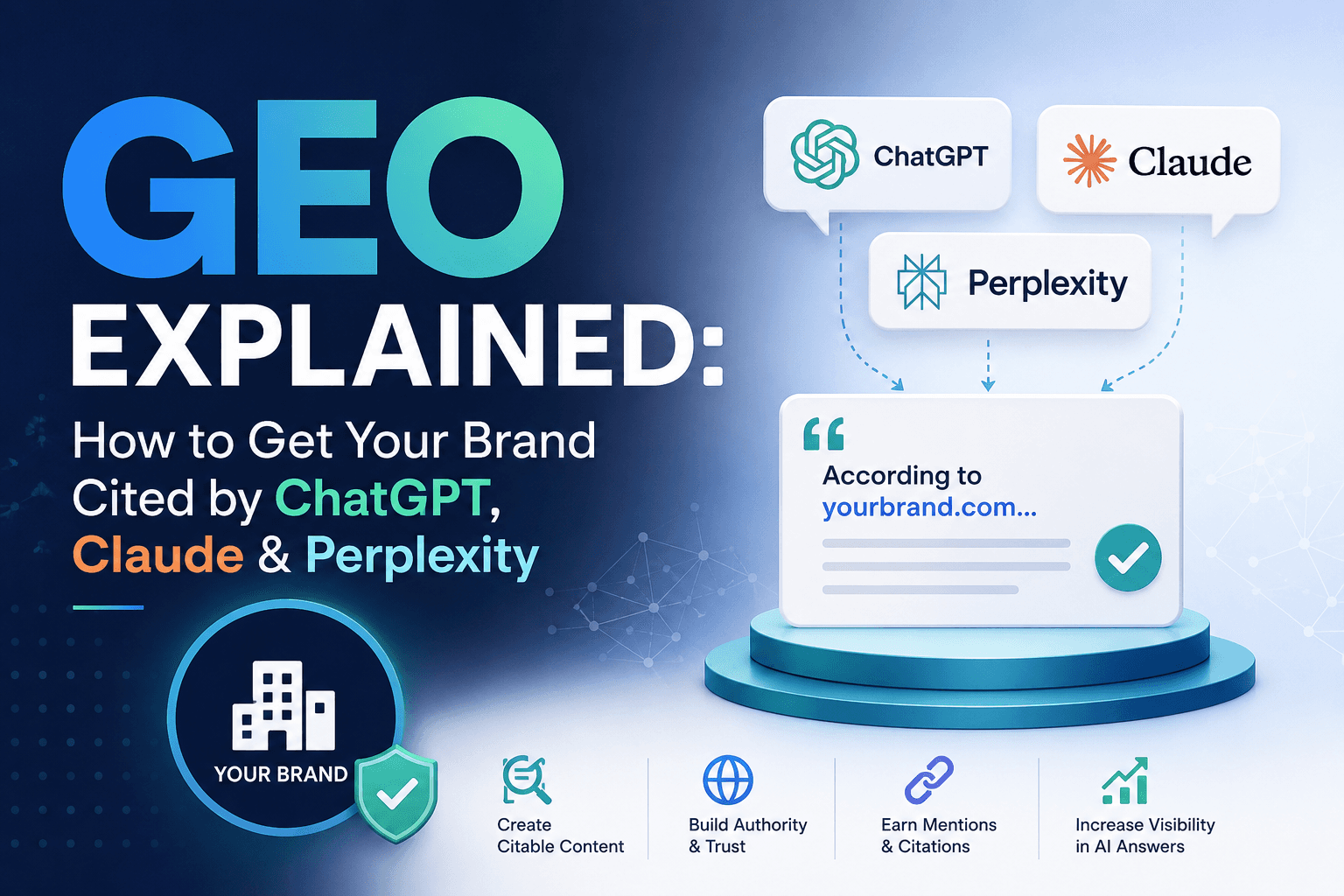
GEO, Not Just SEO: How to Get Your Brand Recommended by ChatGPT, Claude & Perplexity
The currency used to be the click. Increasingly, it's the citation. Here's what that changes — and what to actually do about it.
A few years ago, someone with a question opened Google, scanned ten blue links, picked one, and landed on a page someone like me had carefully optimized. The whole economy ran on that click.
Today that same person opens ChatGPT, Claude, or Perplexity, types "what's the best automation tool for a small marketing team," and reads a clean three-sentence answer. They may never see a results page. They may never visit a single website. They just get the answer — and maybe a couple of citations they don't click.
This is the part of the internet quietly rearranging itself, and it has a clumsy name: Generative Engine Optimization, or GEO. Some people call it Answer Engine Optimization — AEO. The acronyms are still fighting it out in conference talks. I prefer to skip the alphabet and describe what's actually happening.
Name the shift: the Citation Economy
We're moving from a click economy to a Citation Economy. The currency used to be the visit. Increasingly, it's the mention.
Here's the uncomfortable framing for anyone who's built a business on organic traffic: an AI answer engine can read your best article, absorb everything useful in it, synthesize a near-perfect response, and never send you a single visitor. You did the work. The model got the credit. The user got the answer. Nobody clicked.
So the question stops being "how do I rank?" and becomes "how do I become the source the model reaches for?"
That's the whole strategic pivot in one sentence. Everything below is just how to act on it without falling for the hype that's already gathering around three new letters.
What GEO is — and what it isn't
GEO is not a separate discipline that replaces SEO. Most of the foundations overlap: clear writing, genuine expertise, a crawlable site, structured content. If your SEO is sloppy, your GEO will be sloppy too — they share the same plumbing.
The difference is the target. SEO optimizes a page to win a position in a list. GEO optimizes content to be retrieved, trusted, and quoted inside a generated answer — often without a ranking position you can even see.
That changes what "winning" looks like. In SEO you could watch your rank for a keyword and feel something. In GEO, success looks like your brand showing up by name when someone asks an AI a question in your category — and you mostly find out by asking the AI yourself, like a slightly paranoid person interviewing a search engine about their own reputation.
How answer engines decide who to quote
You don't need to reverse-engineer every model to work with the grain of how they behave. A few patterns hold up well enough to build on.
Retrieval favors the findable. Tools like Perplexity — and the search-connected modes of the big assistants — pull live results, then summarize them. If you're not retrievable by a normal web search, you're invisible to the part of the model that's looking things up. SEO basics still guard the door. You can't be quoted from a room nobody can enter.
Freshness matters more than it used to. "Best tools 2026" content that's actually current gets pulled over a stale 2023 post wearing last season's recommendations. Dated, visibly-maintained content reads as more trustworthy to a system whose entire job is to avoid giving an outdated answer.
Structure makes you quotable. Models lift cleanly-stated claims more readily than ideas buried in a meandering paragraph. A direct sentence — "n8n bills per execution, not per task" — is easy to extract. The same fact wrapped in three clauses of throat-clearing is not. Write like you expect to be quoted, because you do.
Consensus builds trust. If several credible sources say a similar thing and your page is one of them, you're safer to cite. Being the lone, unverifiable claim on the internet is a fast way to get politely left out of the answer.
Six practical moves to become quotable
Answer the actual question in the first two sentences. Models — and humans — reward content that states the answer up front and explains afterward. Bury the lede and you bury your citation. Put the takeaway first; keep the suspense for fiction.
Write extractable claims. Short, declarative, verifiable sentences. Give the model clean lines it can lift without distorting your meaning. Think of it as writing pull-quotes for a robot with no patience and a deadline.
Use real structure and schema. Clear headings, direct question-and-answer sections, lists where lists genuinely help. Add schema markup — FAQ, Article, Organization — so machines can parse what your page is actually about. This is the boring plumbing. Boring plumbing is exactly the kind of thing that quietly works.
Show your expertise on the page, not just in your head. Author bios, specifics, dates, named tools, concrete examples. "Experience and credibility" signals matter more when a model is deciding whether you're safe to quote to a stranger.
Keep your cornerstone content alive. Pick the pieces you most want cited and update them on a schedule. A visibly maintained "2026" guide beats an abandoned one every single time. Content isn't a monument; it's a houseplant.
Measure what you can, badly, on purpose. Periodically ask ChatGPT, Claude, Perplexity, and Gemini the questions your customers would ask. Note whether you appear, how you're described, and who's being cited instead. It's not a dashboard. It's a flashlight in a dark room. Use it anyway.
A weekend GEO audit you can actually run
If you want to start without buying anything, this is enough:
List 10 real questions your customers ask before they buy in your category.
Ask all four assistants (ChatGPT, Claude, Gemini, Perplexity) each one. Screenshot the answers.
Mark three things per answer: Do you appear? How are you described? Who's cited instead of you?
Find the gap. For every question where a competitor is quoted and you aren't, check whether you even have a clear, current, well-structured page answering it. Usually you don't.
Fix the obvious one first. Pick the highest-intent question, write the cleanest answer on the internet for it, add structure and schema, and re-check in a few weeks.
The honest caveats
This is where I have to be a killjoy, because GEO is already attracting the same breathless energy that made early SEO insufferable — the webinars, the "secret signals," the people selling certainty about a system designed to resist it.
You cannot fully measure GEO yet. There's no clean rank tracker for "how often does Claude mention me." The tooling is young and the answers are non-deterministic — ask the same question twice and you may get two different sets of sources. Treat any "AI visibility score" with the skepticism you'd give a horoscope that came with a confidence interval.
You cannot game trust. The whole point of how these systems weight sources is to be hard to manipulate. Keyword-stuffing for robots will age about as well as it did in 2011. The durable move is genuinely being a credible source — which, inconveniently, takes actual expertise and time.
And GEO will not save thin content. If an AI reads your page and finds nothing worth quoting, perfect structure won't help. The plumbing makes good content findable. It cannot manufacture substance that was never there. This is the same lesson SEO taught us, wearing a newer jacket.
The part the machines don't do
Even in a world where AI answers most of the questions, somebody still has to decide which answer to act on — which tool to actually buy, which source to trust with a real budget, which recommendation to forward to their boss with their name attached to it.
The Citation Economy changes who gets mentioned. It doesn't remove the human at the end who makes the call. Your job is to be the brand that's both quoted by the machine and trusted by the person reading the machine's answer.
Optimize for the citation. Earn the trust. The click, if it still comes, is a bonus.
The internet didn't stop rewarding good work. It just changed where it puts the reward. The brands that win the next few years won't be the ones who found a clever trick — they'll be the ones who were genuinely worth quoting, and made themselves easy to quote. That's a less exciting answer than a secret hack. It's also the only one that keeps working after the hype moves on to the next three letters.
The short version
GEO is a shift in target — be the quoted source — not a replacement for SEO fundamentals.
Answer the question up front; write short, extractable, verifiable claims.
Add schema, keep cornerstone content current, show real authorship.
You can't fully measure it yet — audit by asking the AIs your customers' questions.
You can't game trust, and thin content stays invisible. Be worth quoting first.
Frequently asked questions
What is Generative Engine Optimization (GEO)?
GEO is the practice of optimizing content so AI answer engines like ChatGPT, Claude, Gemini, and Perplexity retrieve, trust, and quote it inside their generated answers — rather than only ranking it in a list of links. It shares foundations with SEO but targets the citation, not the click.
Is GEO different from SEO?
GEO doesn't replace SEO. Most foundations overlap: clear writing, genuine expertise, a crawlable site, structured content. The difference is the target. SEO optimizes a page to win a position in a list of results. GEO optimizes content to be retrieved and quoted inside a generated answer — often with no visible ranking position at all.
How do AI answer engines decide which sources to cite?
They favor sources that are findable by normal web search, freshly maintained, clearly structured, and corroborated by other credible sources. Short, declarative, verifiable claims are easier to extract and quote than ideas buried inside long paragraphs.
Can you measure GEO in 2026?
Only roughly. There's no clean rank tracker for how often an AI mentions you, and answers are non-deterministic. The practical method is to periodically ask the major AI assistants the questions your customers would ask, then note whether you appear, how you're described, and who gets cited instead.
Do I still need SEO if I'm doing GEO?
Yes. Retrieval-based answer engines lean on normal web search to find sources. If your SEO basics are broken — uncrawlable pages, no structure, stale content — the model can't find you to quote you. GEO sits on top of SEO; it doesn't bypass it.