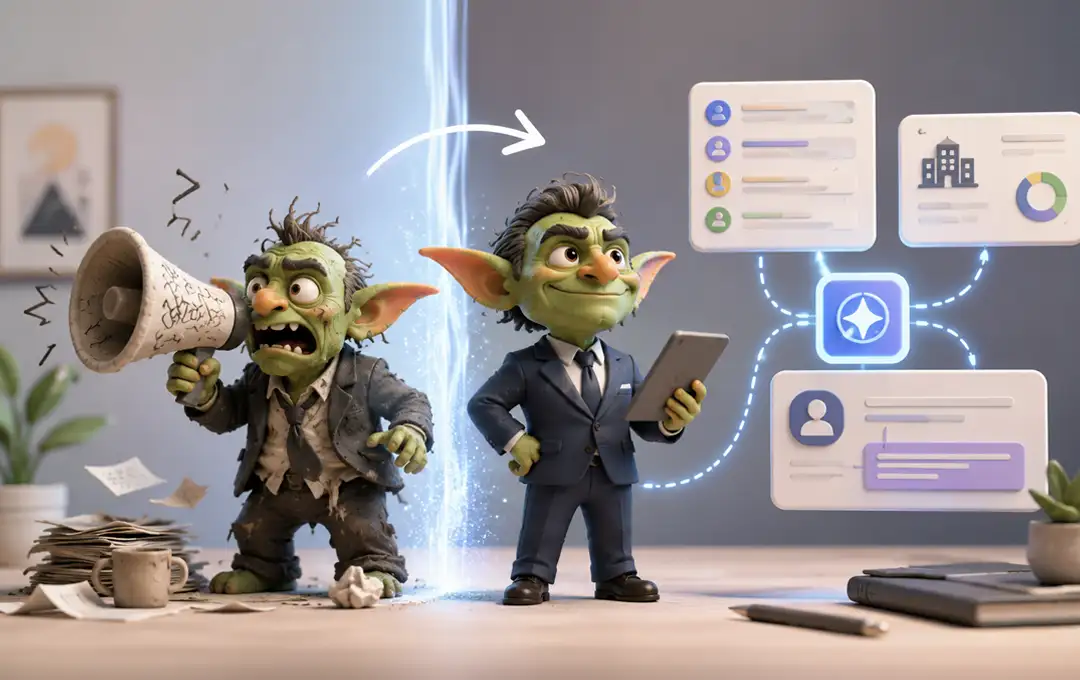
You know the type.
The LinkedIn message that arrives at 8:47 AM on a Tuesday, addressed to "Hi [FIRST NAME]," promising to "revolutionize your pipeline" with a tool you've never heard of, sent by someone whose profile picture is a blurry photo taken at what appears to be a networking event in 2016.
This is the Sales Goblin. Not a villain, exactly — more of a tragic figure. Armed with a list, a template, and boundless optimism, the Sales Goblin fires off 500 messages a day and mistakes volume for strategy.
What separates a smart B2B prospector from a Sales Goblin isn't the number of tools they use. It's knowing why they're reaching out, to whom, and with what kind of intelligence backing the message.
Clay is one of the few tools that can genuinely help you cross that line — if you use it right.
What Is Clay, Actually?
Clay is a data enrichment and prospecting automation platform. Think of it as a spreadsheet that went to therapy, discovered its purpose, and came back with superpowers.
At its core, Clay lets you:
Pull leads from various sources (LinkedIn, Apollo, Hunter, etc.)
Enrich those leads with dozens of data providers at once using waterfall enrichment
Write AI-generated, context-aware outreach messages at scale
Push the whole clean, enriched, personalized mess into your CRM or email tool
The pitch is simple: spend less time manually researching prospects, more time having actual conversations with people who are the right fit.
The problem is that "automation" and "personalization" are words that live in different neighborhoods. Clay is powerful enough to make them neighbors — but only if you do the setup work.
The Waterfall Enrichment: Why It Changes Everything
Here's a thing that happens constantly in B2B outreach: you have a name and a company, but you're missing an email. You pay for Apollo. Apollo doesn't have it. You try Hunter. Hunter shrugs. You give up and blast a generic LinkedIn message.
Clay's waterfall enrichment fixes this quietly and elegantly.
Instead of querying one data provider and stopping, Clay sequences through multiple providers — Apollo, Hunter, Datagma, DropContact, Clearbit, and more — stopping only when it finds what you need. This means you're not paying for failed enrichment attempts, and you're dramatically increasing your match rate.
For a solo operator or a lean B2B team, this alone is worth the price of admission. You build one table, define your enrichment cascade, and Clay handles the data detective work. What used to take a VA three hours of tab-switching now runs overnight.
The business case here is straightforward: better data quality → higher deliverability → better reply rates. You're not sending more emails. You're sending smarter ones to people who actually exist at the address you have.
AI Columns: Where Personalization Stops Being a Lie
Most "personalized" outreach is not personalized. It's mail-merge with delusions of grandeur.
"I noticed you work at [COMPANY] in the [INDUSTRY] space — impressive!"
Nobody is fooled. The Sales Goblin has entered the chat.
Clay's AI columns are genuinely different. You can prompt Claude (yes, that Claude) or GPT-4 directly inside a Clay table, feeding it enriched data about each prospect and asking it to generate something actually tailored.
Here's a real example of what this looks like in practice:
You've enriched a list of 200 SaaS founders. For each one, Clay has pulled their recent LinkedIn posts, their company's funding stage, their tech stack, and their job postings (which are a goldmine for understanding priorities). You write a single AI prompt that says: "Based on this person's recent activity and company growth stage, write three sentences explaining how [your product/service] could solve a specific challenge they're likely facing right now."
The output isn't perfect every time. You review a sample, refine the prompt, re-run. But the resulting messages have context. They reference real things. They don't start with "I hope this email finds you well."
This is the difference between automation that replaces thinking and automation that amplifies it.
Trigger-Based Prospecting: Timing Is the Real Superpower
Here's the underrated use case that separates Clay power users from everyone else: trigger-based outreach.
The best time to reach out to a prospect isn't when your quota needs filling. It's when something has just changed for them. A new funding round. A new job title. A job posting for a role that signals a strategic shift. A LinkedIn post where they publicly complained about a problem you solve.
Clay can pull these signals and turn them into prospecting triggers.
A simple workflow:
Monitor a list of target companies for new LinkedIn job postings
Filter for postings that include specific keywords related to your ICP's pain points
Enrich the decision-maker's contact at that company
Generate a message that references the job posting as context
Push to your outreach tool with a 24-hour delay so it doesn't look like a bot sneezed on it
The message the prospect receives doesn't say "I saw you're hiring." It says something like: "I noticed you're scaling your data operations team — a lot of companies at that stage run into [specific problem], and it's something we've helped [similar company] solve."
That's not a Sales Goblin. That's a person who did their homework. The automation is invisible because the intelligence is real.
What Not to Do (The Goblin Traps)
Since we're being honest about the tool's potential, let's be equally honest about how people ruin it.
Trap 1: Volume without targeting. Clay makes it very easy to enrich 5,000 leads at once. Resist the temptation. Smaller, tighter lists with real ICP fit will always outperform spray-and-pray. You're not running a newsletter; you're starting a conversation.
Trap 2: AI copy-pasting without human review. The AI columns are a first draft, not a finished product. Read a sample. Catch the hallucinations. A message that confidently references the wrong product or a non-existent LinkedIn post will do more damage than a generic one.
Trap 3: Over-enriching before validating the list. Running a waterfall enrichment on a bad list burns credits and time. Validate your ICP criteria before you enrich. Clay is not a list-cleaning tool — it's a signal amplifier. Garbage in, enriched garbage out.
💳 Clay Pricing: What You'll Actually Pay in 2026
Note: Clay overhauled its pricing in March 2026. If you're evaluating the tool now, here's what the current structure looks like — because "credits" can get confusing fast.
Clay now runs on two separate credit types: Data Credits (for enrichment lookups) and Actions (for platform operations like running workflows). Both are consumed per task, and the plans are usage-based rather than seat-based — all tiers include unlimited users.
Plan | Monthly (billed monthly) | Monthly (billed annually) | Best For |
|---|---|---|---|
Free | $0 | $0 | Testing the interface, 100 credits/month |
Launch | $185/mo | $167/mo | Solo operators, small teams getting started |
Growth | $495/mo | $446/mo | Teams running real volume; includes unlimited credits & actions |
Enterprise | Custom | From ~$30K/year | Large GTM teams, dedicated support, SSO, Snowflake |
A few things worth knowing before you commit:
Failed lookups still cost credits. If Clay queries three providers and none return a valid email, you pay for all three attempts. This makes clean, well-targeted lists essential — not optional.
Top-up credits cost 50% above your plan rate on the Launch tier. The Growth plan eliminates this by including unlimited credits, which is a strong reason to move up if you're running consistent volume.
CRM integrations (Salesforce, HubSpot) are only available on Growth and above. If syncing to your CRM is part of the plan, factor that in from the start.
LinkedIn Sales Navigator isn't included and can add ~$99/month per user if LinkedIn is a primary enrichment source.
For most solo operators and lean B2B teams exploring Clay seriously, the Launch plan is a reasonable starting point. For teams building repeatable outbound workflows at scale, Growth is where the math starts to make sense.
The Bottom Line
Clay is genuinely one of the most interesting tools in the B2B automation stack right now — not because it's magic, but because it moves the bottleneck from data collection to strategic thinking.
The Sales Goblin doesn't fail because of bad tools. The Sales Goblin fails because they outsource the thinking to the volume. Clay can automate the data work, the enrichment, even parts of the copy — but it can't automate judgment. It can't tell you who actually matters to reach, or why, or what you have to offer them that's genuinely worth their time.
That part is still yours to figure out.
But once you have it figured out? Clay will help you execute it at a scale that would have required a whole SDR team two years ago.
Which is either exciting or terrifying, depending on which side of the outreach you're on.
Derya Balcı writes about AI tools, automation, and the occasional existential crisis triggered by a well-timed workflow. If you found this useful, you might also like [insert related post here].